Tuesday, November 27, 2018

Virgin Galaxies

Image result for outer space gif
   Today, I completed a series of tasks about virgin galaxies. I learned a lot about not only that though; I also learned a lot about new technology I can use in the classroom once I become a teacher. I used Google drawing for the first time while completing this activity. I really like this program because I'm not too great of an artist usually, but it's so easy to draw with it. I can use it in my future classroom whenever I have to draw something for my students. This program is also easy enough for students to use themselves. You can check out my Google drawing here. My drawing is of the earth, the atmosphere and the International Space Center. I estimated the distances between all of those things, and then drew Mount Everest on earth, and labeled its height, which is 5.5 miles high.Image result for dark matter gif   I also learned a lot about outer space in general while completing these tasks. Something really cool that I learned was that there is a "super-earth" that scientists have recently discovered. This "planet" is next to Bernard's star, which is the closest star to our sun that we know of. We believe it to be very icy and cold. What's really interesting about it though, is that scientists believe that there may be life there. Even though it's really cold, scientists still believe that it could support life. We believe that this "planet" is about 6 light years away, which means it would take over 100,000 years of travel to reach. "After a very careful analysis, we are 99 percent confident that the planet is there," Ignasi Ribas, of the Institute of Space Studies of Catalonia and the Institute of Space Sciences in Spain, said in a statement. This is fascinating to me, and I would like to learn even more about other life that may exist on other planets. If you would like to learn more about this, the article is linked here.
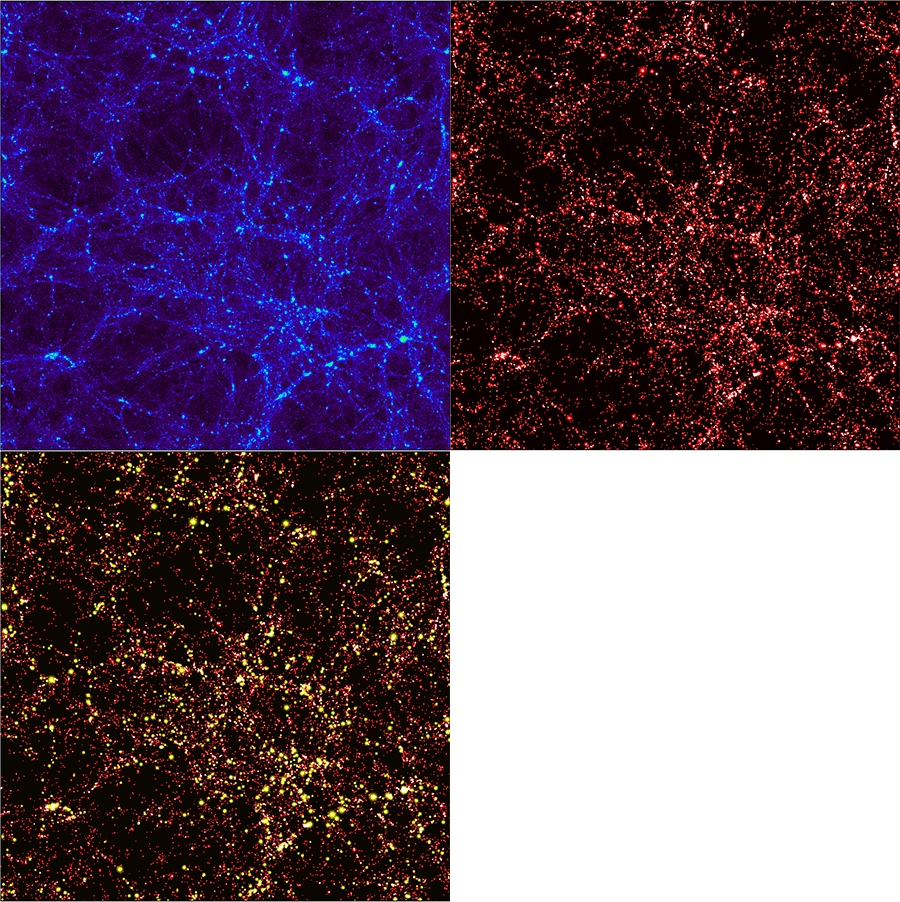
   Something else I wanted to research after this lesson was dark matter. The last link in the series of tasks brought me to Wonderopolis, which is a website where teachers and students can look up things that they have wonders about and find resources to help learn about them. While on this site, I learned that dark matter is a hypothetical type of matter that scientist believe makes up over 85% of the total matter in the universe. Wonderopolis helped me find this answer very easily, and I would use the tool again in the future to find information about my wonders.   After completing all of these activities, I think that I have figured out my method of teaching this topic to students. I absolutely would teach this in an inquiry lesson following the five E's: engage, explore, explain, elaborate and evaluate. This would allow the students to explore and learn by themselves about this topic. Virgin galaxies and outer space is most certainly a topic that students are going to have questions about; so it is best to let them explore and answer those questions. Students should also make hypotheses about these questions before they explore their answers. Inquiry is one of the most fun, student-centered ways to learn, and is highly appropriate for this topic.


Wednesday, November 14, 2018

Teaching Earth Science!

   Yesterday, my class and I all split into groups and presented all about different kinds of earth science! There were presentations about the ocean and pollution, instruments used to measure weather, violent weather and earth's atmosphere. These presentations were all engaging and informative and provided me with a lot of new information on these topics and how to teach them to my future students one day. My group presented to the class about Pangaea and the earth's surface. You can find the link to my groups presentation here. Check it out!
   I gained a lot of new insights on teaching through exploring this topic and creating this presentation. My group and I chose to do this topic because we decided that we did not know a lot about it at all, and it would benefit us as future science educators to learn it now. We decided to focus in on Pangaea as well because Pangaea and other supercontinents that have existed throughout history shift the earth's surface. Something really interesting I learned from this presentation was that there will in fact be another supercontinent one day. A supercontinent like Pangaea forms about every 600 years. Pangaea existed about 300 years ago, meaning that we are about halfway to having another supercontinent exist. This is because the earth's plates are constantly moving and shifting; sometimes the plates shift together and sometimes they shift apart, making the land closer or farther away from each other. I did not know this before our project; I thought Pangaea was the only supercontinent that we would ever know, but that is not the case.
   I also learned all about a new technology that I can use to collect and store student answers during a lesson. It's called mentimeter. Mentimeter is an app or online program that lets the teacher ask questions in a variety of ways and get the responses in real time. It can be used as a pre-assessment, check for understanding or post-assessment during a wide array of lessons. During my groups lesson, we used mentimeter for all three! You can ask basic multiple choice questions or true or false questions, or you can do something like a word cloud, which is a much more interactive way to display the responses and collect student data. This is a great form of technology to use and is appropriate for all ages! Check out this link and see how mentimeter works and how my peers answered the questions we gave them.


Wednesday, October 24, 2018

Farewell Letters From the Past

Dr. Smirnova was kind enough to give us a chance to read 10 letters from students who were previously in the Science Methods course, which I'll link here. I read them at the beginning of the semester, and they were all very helpful in seeing what I was getting into with this course. While reading the letters, I noticed a few common themes at most of the students seemed to emphasize. Number one, I learned that I must be organized to succeed in this class. This is true for all classes, but especially this one. Dr. Smirnova doesn't always tell you when things are due, but that is for a reason; she wants us to be independent and responsible for completing the assignments on our own. This is kind of different than what I'm used to, but the students from the past assured me that as long as I stay organized, I'll be fine. Another thing that was emphasized in the letters was the fact that this class really prepares you to be a great teacher. That's really nice to hear because I know that even when I'm struggling with an assignment, I have to push through and do it because in the end, it'll make me a much better teacher. Even assignments that I don't necessarily agree with or struggle to figure out, I know will help me later down the line, which makes doing them much more worthwhile. The last point that a lot of past students emphasized was that Dr. Smirnova really will do anything for her students to succeed. That is something that is very valuable to me as a student; knowing that I have a teacher who is 100% in my corner and will stop at nothing to help me succeed. Halfway through the semester, I already have seen that's the truth. When my group and I stayed up late the night before our inquiry lesson, Dr. Smirnova was right there with us, face timing and calling us late at night, just to give us some extra resources or feedback. This was very beneficial to me and my group, just as these letters from the past were. These letters helped me see what I can expect for the semester, and I'm looking forward to writing one of these of my own for the students next semester!


Tuesday, October 23, 2018

"Scientists are Always at the Drawing Board"

   Neil deGrasse Tyson is an astrophysicist, author, and science communicator. In the video linked below, he is answering a couple of questions at a science convention of some sort. He talked about how 96% of the universe is still undiscovered and unknown, which is extraordinarily exciting for scientists. Because of this, scientists will absolutely never run out of things to study and learn about. But something Tyson said really caught my attention and got me thinking. He said that "scientists are always at the drawing board". He is totally right. The only thing constant about science is that it's always changing. New information is being discovered every single day by scientists all over the world. Not only that, but we are also learning everyday things that contradict what we thought we already knew about science. Science textbooks and journals are constantly rewritten and edited as we find new information, which makes it so a scientists job is never officially done. This can be frustrating, but with the right mindset is extremely exciting. We will never stop learning about science, and as Tyson said, we'll always be "at the drawing board".


My Inquiry Lesson!

   Two days after my direct instruction lesson, my group and I once again presented a lesson in front of a whole class. However, this lesson was a little different; it was an inquiry lesson. The difference between a direct instruction and inquiry lesson is that a direct instruction lesson is very teacher-centered, whereas inquiry lessons are much more student-centered. In our inquiry lesson, our students needed to help out an "alien visitor" that wanted to know what life was like on earth. So, the students took turns reading riddles and guessing what plant organelle each riddle represented. At the end of all of the riddles, the students had to write a letter to the alien, describing to him what they know about plant organelles. Overall, I think the lesson went well.


   The students seemed to enjoy the riddles, and guessing what organelle the riddle was talking about. They guessed and discussed the riddles together as groups, which I think helped the inquiry process. The students were much more engaged doing this process as a group rather than as individuals. I also think that the students liked the "alien visitor", especially the fact that one of my group members actually recorded an alien voice for the students! We played it before the students started their inquiry, and I think it got them even more excited to start the process. During the inquiry process, the students also created their own cells. After they guessed the right organelle, the students would take a cut out of that organelle, color it, glue it onto their piece of construction paper, and label it. My group wanted the students to have something to keep or maybe even take home with them from our lesson, and we thought this was a good way to do that. However, the students cells did not end up going the way my group and I planned.

   The students did not end up having enough time to finish their cells, which is unfortunate. However, they had the supplies to finish them on their own if they chose to do so, which my group and I were happy about. Something else that didn't go according to plan during our lesson was our review game that we wanted to play in the beginning with the students. This game would've gone over all of the organelles we went over a couple of days prior, and activated the student's prior knowledge. But, QR code for the game didn't work, so we didn't get to do the game. I think that playing the game would've definitely helped the students solve the riddles better and more quickly, because it would have went over the organelles and their functions.

   Teaching this lesson was much different than teaching the direct instruction lesson. In this lesson, the students were much more hands on, making it an entirely new challenge. However, through teaching this lesson I realized that these types of lessons are very beneficial for students. They get to be hands on, and research and learn deeply about a topic. I will absolutely use this type of lesson in my future classrooms, especially during science instruction.

My Direct Instruction Lesson!

    On September 18, my group and I had the opportunity to present a direct instruction lesson to a group of fourth-grade students. We taught them about botany and plant oragnelles. I did very well, even though there were a few things that we could've improved upon.It was nerve-racking, but overall an awesome experience that gave me a chance to teach in front of a whole class for the first time. I was a little intimidated at first because my group and I were the first ones in our class to go, and we weren't sure exactly what to expect. We prepared a lot for our lesson, but not seeing a lesson with this class beforehand worried me a little bit. However, I think my group and I did a great job, even though we had some things to improve on.
    I thought my group and I did a good job of controlling the class through a lot of the lesson. The fourth-grade class we were teaching was full of good kids who were ready to learn, but as a whole, could get pretty rowdy from time to time. My group and I did a good job handling this though, and had a few different ways to refocus the class when they were getting a little out of hand. We would clap a certain way, and then the class would clap that same way back to us. There was also a button in the classroom that we used that played a snippet of a song, which indicated to the class that they had to settle down and refocus. I thought we used these strategically and they definitely helped our lesson out. I also thought we all did a great job using appropriate teacher voices and interacting with the students. I know we were all really nervous before we presented, but I don't think that you could tell. All of my group members sounded very confident while they were presenting, which I know was not easy considering this was our first experience teaching in front of a whole class. I also thought we all did a very nice job addressing the students by name, and making sure that we got multiple student responses for each question. Although it was a direct instruction lesson and was supposed to be teacher-centered, we didn't want the students to just sit and take notes for an hour. So, we interacted with the students as much as possible. I also think that the students really enjoyed our rap at the end about plant organelles. By the second time we played it, the kids knew the words and were singing along! However, there were also a few things that I feel that my group and I could've done better.
    I thought that I could've done a better job with time management. I spent way too much time at the beginning of the lesson explaining classroom rules and basic stuff that I should've quickly covered. This led to other members of my group having to rush through their parts so that we could finish everything on time. Every second in the classroom is valuable, and can't be wasted. Next time I teach, I will definitely keep a better eye on the clock, and use classroom time appropriately. I also feel as though I could've prepared my part a little bit better, and next time definitely will do so. I thought I was prepared going into the lesson, but I wasn't as prepared as I should have been, and it won't happen again.
     Although my group and I didn't have a perfect lesson by any means, I thought that for the first group, and for the first time any of us had taught a whole class, it went very well. I learned a lot about what to do, and what not to do when teaching a whole class, and that is very valuable information for me as I continue my teaching career.

Monday, October 1, 2018

Flipgird Presentations


     One of my favorite new apps that I've discovered since beginning the Science and Technology Methods course is Flipgrid. Flipgird is a great way to post personalized videos about yourself, and show them to your students. It's also a place where you can have students submit their work for a project or an assignment, all in one place! My class and I all submitted our own flipgirds, where we answered the following four questions; what's your name and program? If you could pick any superpower, what would it be? What is something awesome you did this summer? Ask a question you want all your future students to answer. We also had to show a "secret talent" in our video. I decided to shoot a basketball as my talent, but there was a big variety of talents my classmates picked. One of them juggled, one of them was a baker, and one of them was a clarinet player. Seeing my classmates "secret talents" was my favorite part of the flipgrid presentations. It really helped me learn a little bit about each of my classmates personalities.
      After watching the flipgrid presentations in class, the presenter would get feedback on eclass from each of their peers. We would give this feedback in the form of three pluses and one wish. This means that everybody would tell the presenter three things they did well, and one thing they could have improved on. I really liked this feedback because it gave me a chance to see what I need to improve upon, but not before it told me a lot of nice, positive things about my presentation and flipgird. The main wish my classmates had for me was that I slowed down when talking, and I think that this is a fair criticism. I was a little nervous before my presentation, and I could definitely sense that I was going a little fast when I was up there This type of feedback was very beneficial, and I will definitely consider using it in my future classroom!

    Flipgrid is an overall great way for teachers to get quick, fun responses from students. And for students, flipgrid is way more interesting than your typical get to know you activity. I will absolutely find a way to fit flipgrid into my lessons occasionally, as I think they are really beneficial. If you want to check out my flipgrid or any of my classmates', take this link here to our class slideshow. On this slideshow, not only do you get to see all of our flipgrids, you also get to see a picture of us, and our drawings of scientists that we made on our first day of class. Check it out!


Science in the News

  Wouldn't it be cool if you could go into space? Well, that may now be a possibility! Thanks to Richard Branson, who started Virgin ...